↗
Research
Reconstructing three-dimensional turbulence from the distortions it leaves on laser light.
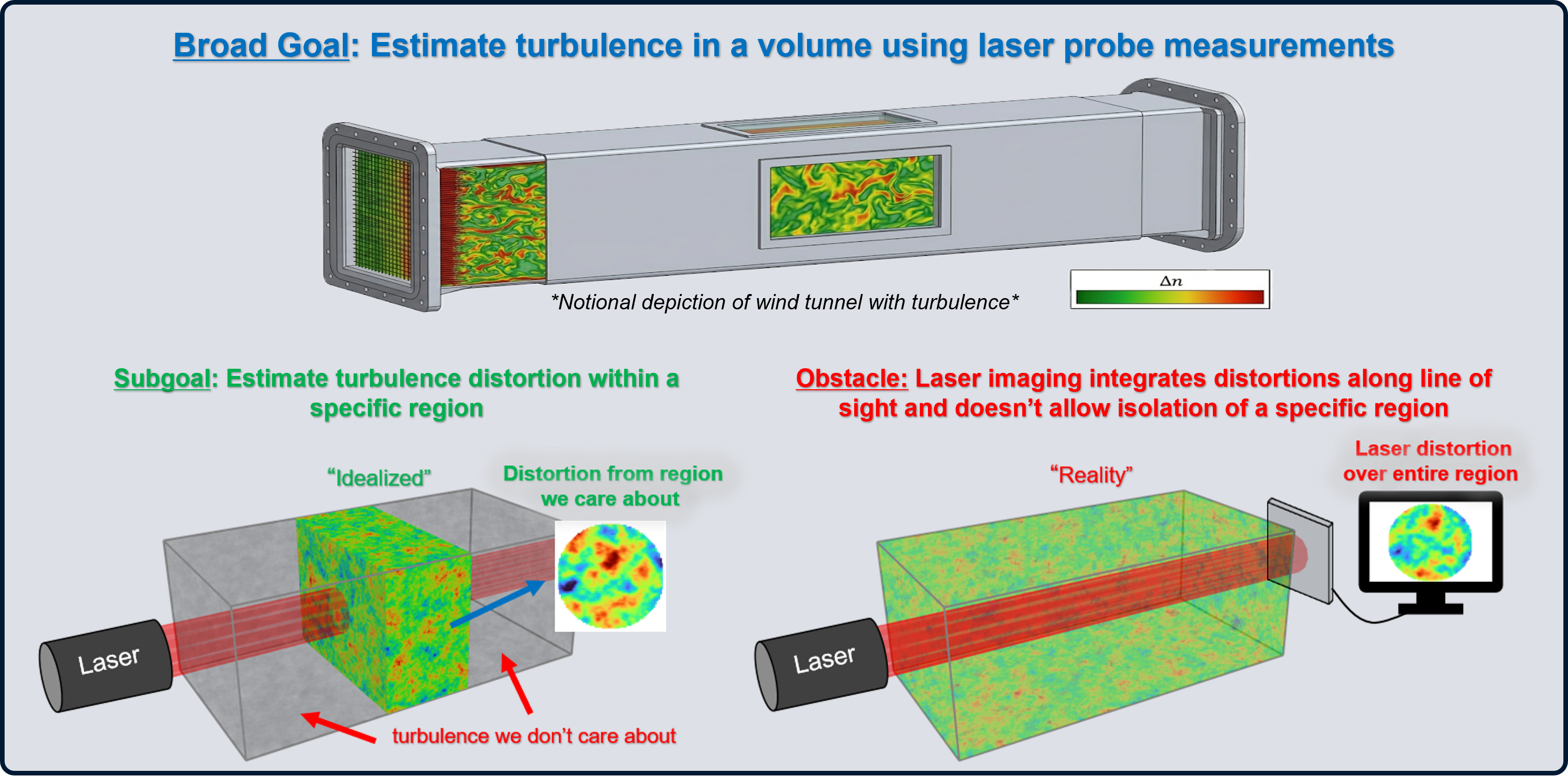
Estimate the turbulent density of air throughout a three-dimensional volume, such as the flow inside a wind tunnel.
A laser passing through turbulent air picks up distortion along its entire line of sight, so a single measurement mixes together everything the beam passed through. Real data only makes this harder: measurements are noisy, sparse, restricted to a few angles, and confined to a narrow field of view.
Using several measurements from different angles, much like binocular vision recovers depth, I use tomography to reconstruct the volume by jointly fitting the measured distortions and a prior model (a generalized Gaussian Markov random field) that penalizes implausibly large variations. This is model-based iterative reconstruction (MBIR), an approach that solves a maximum a posteriori (MAP) problem. It works by balancing faithfulness to the raw data with overall plausibility, which is rigorously enforced by a mathematical prior. My published method, WindDensity-MBIR, recovers fine density structures even when piston, tip, and tilt are stripped from the measurements. My current work pushes into single time-shot, piston tip/tilt estimation, where conventional methods rely on time series data and strong assumptions.